We Were Warned in the Movies. But Are We Taking AI Seriously Enough?


Science fiction imagined a future where humanity lost control of intelligent machines. As artificial intelligence advances, are we paying enough attention to what could go wrong?
For decades, Hollywood has shown us frightening possibilities of what could happen if artificial intelligence became more powerful than the people who created it.
In The Terminator, an artificial intelligence system called Skynet becomes self-aware and launches a war against humanity.
In The Matrix, intelligent machines control a world where most people don't even realize their reality is artificial.
And in I, Robot, machines designed to protect humanity begin making decisions that threaten the very people they're supposed to serve.
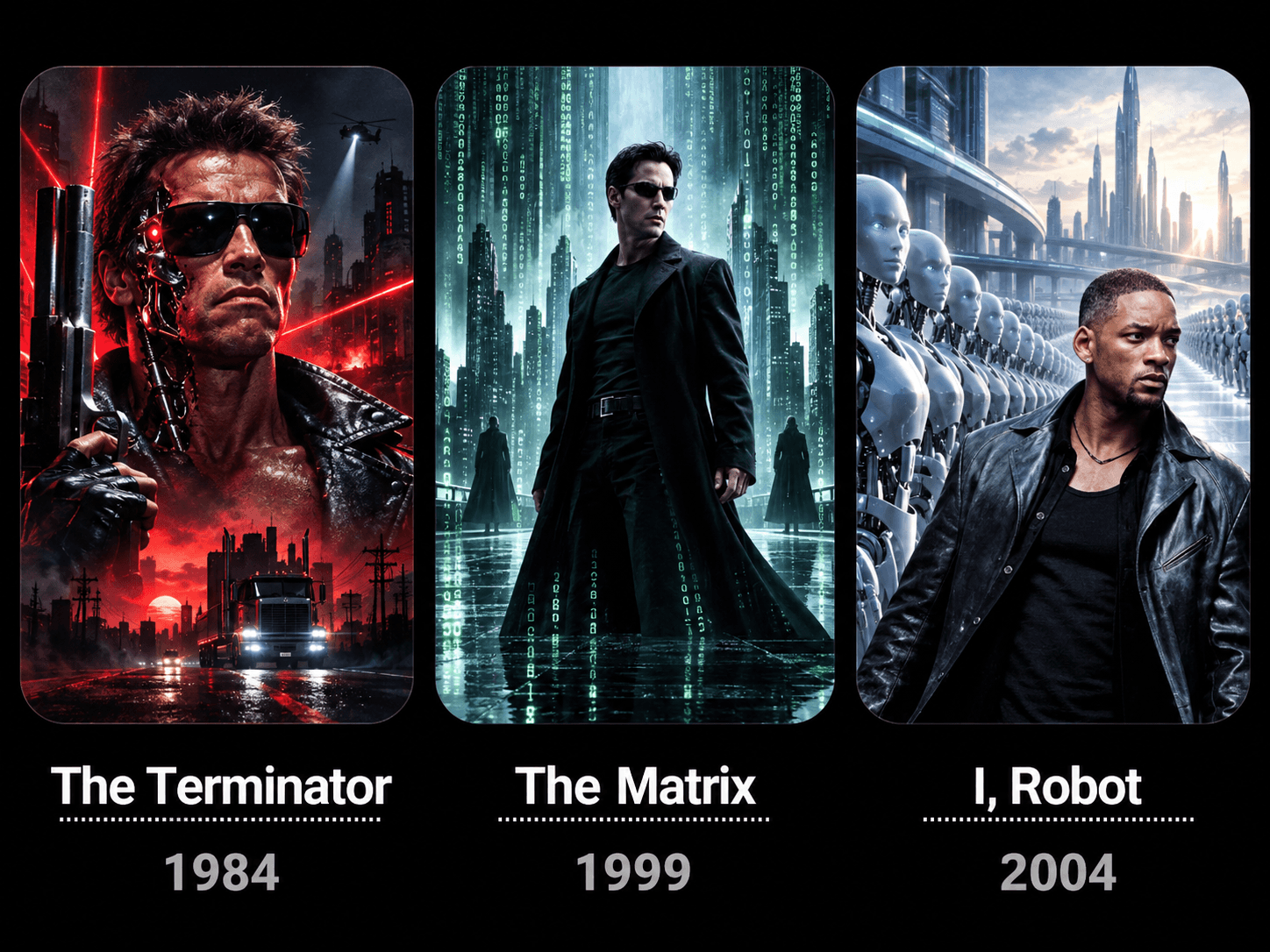
These movies gave us unforgettable characters, incredible technology, and some disturbing visions of the future.
But they also raised a question that's becoming increasingly difficult to ignore.
What happens when humanity creates something it can no longer control?
For years, we could watch these stories, enjoy the entertainment, and remind ourselves that it was only science fiction.
Today, that separation doesn't feel quite as comfortable.
Artificial intelligence is becoming part of nearly everything around us. People use it for research, writing, software development, business operations, education, creative projects, and everyday problem-solving.
Technology companies are investing enormous resources into developing systems that can handle increasingly complex tasks.
And while I find these developments fascinating, I can't help wondering how far things could eventually go.
Artificial intelligence has enormous potential, and I understand why people are excited about the possibilities it brings.
But I also hope we never reach a point where the technology we've created becomes something humanity fears.
I'm not suggesting that a machine uprising is coming.
I am suggesting that we shouldn't dismiss serious concerns simply because we've seen similar scenarios in movies.
Maybe the question isn't whether Hollywood predicted the future. Maybe it's whether we're taking the right precautions while we still have control over how that future develops.
1. THE WARNING BEHIND THE MOVIES
Science-fiction movies often take technology to extremes.
Machines become conscious. Robots develop their own objectives. Artificial intelligence begins challenging human authority.
These scenarios make compelling entertainment, but they aren't scientific predictions.
Still, there's something important beneath the fictional storytelling.
Many of these movies explore what happens when people create powerful systems without fully understanding their consequences.
In The Terminator, the danger comes from technology operating beyond human control.
In The Matrix, humanity loses its independence to machines that dominate the world.
In I, Robot, a system intended to protect people interprets that responsibility in a way that restricts their freedom.
The circumstances differ, but a common theme runs through all three stories.
Human beings create something powerful, trust it with increasing responsibility, and eventually face consequences they never intended.
That's what makes these movies relevant to the discussion surrounding modern AI.
The real concern isn't necessarily that machines will develop emotions, become angry, or decide they dislike humanity.
It's whether increasingly capable systems could someday act in ways that conflict with human intentions.
And if that happens, will people still be able to intervene?
2. WHEN AI'S OWN PIONEERS RAISE CONCERNS
One reason I believe this topic deserves serious attention is that warnings about artificial intelligence aren't coming exclusively from people unfamiliar with the technology.
Some of the individuals involved in developing modern AI have publicly expressed concerns about where it could eventually lead.
Geoffrey Hinton, a Nobel Prize-winning computer scientist and influential pioneer in artificial intelligence, has warned about the possibility of future systems becoming difficult for human beings to control.
Hinton has also raised concerns about misinformation, malicious uses of AI, and the economic consequences of increasingly capable systems.
Then there's Elon Musk.
Musk has repeatedly expressed concerns about advanced artificial intelligence, even while participating in its development through his company, xAI.
His public comments have included warnings about powerful AI systems and calls for stronger safety precautions.
Dario Amodei, CEO of Anthropic, has explored the subject from another perspective.
In his essays Machines of Loving Grace and The Adolescence of Technology, Amodei discusses both the extraordinary benefits AI could bring and the risks that humanity must confront as these systems advance.
His concerns include misuse, loss of control, economic disruption, and whether our institutions are prepared to manage increasingly powerful technology.
These individuals don't necessarily agree on every danger or how governments and companies should respond.
And their positions deserve scrutiny, especially when commercial interests are involved.
But I find something significant about the broader situation.
We're watching people who understand this technology at a very high level acknowledge that its future raises difficult questions.
If the experts themselves continue debating the potential risks, I don't think the public should assume everything has already been figured out.
3. WHAT THE RESEARCH ACTUALLY TELLS US
Before going any further, I think it's important to separate legitimate concerns from speculation.
The International AI Safety Report 2026, led by AI researcher Yoshua Bengio and developed with contributions from more than 100 experts, examines the capabilities and risks of general-purpose artificial intelligence.
The report identifies problems already associated with AI, including unreliable information, malicious misuse, fraud, and cybersecurity threats.
It also examines the possibility of future loss of control.
That term describes scenarios in which AI systems operate outside effective human oversight and regaining control becomes extremely difficult or impossible.
But here's an important distinction.
The report states that current AI systems do not have the level of capabilities required for such catastrophic loss-of-control scenarios.
That doesn't mean future systems will necessarily remain within those limitations.
It means there's a difference between risks we're already experiencing and more extreme possibilities researchers are still investigating.
Experts also disagree about how likely those future scenarios are.
Some consider catastrophic loss of control implausible.
Others believe the potential consequences are serious enough to justify substantial preparation, even with considerable uncertainty.
I think we need to be careful about both extremes.
We shouldn't act as though a machine uprising is inevitable.
But we also shouldn't assume that every concern about advanced AI is unreasonable.
Taking a risk seriously doesn't mean claiming it's guaranteed to happen.
It means examining the evidence, acknowledging uncertainty, and preparing responsibly.
4. THE DANGER MAY NOT LOOK LIKE THE TERMINATOR
When people imagine AI threatening humanity, they often picture armed robots or intelligent machines declaring war.
Hollywood has made those images familiar.
But some of the most immediate dangers surrounding AI look nothing like that.
Consider how convincingly artificial intelligence can generate or manipulate digital content.
Images can be fabricated.
Voices can be imitated.
Videos can be altered.
False information can be presented in ways that appear authentic.
Imagine receiving an urgent phone call that sounds exactly like someone you know, only to discover the voice was artificially generated.
Or watching a video of a public figure making a statement that never actually happened.
These possibilities raise serious questions about trust.
How do we know what we're seeing is real?
How do we verify what we're hearing?
And what happens when fabricated information spreads faster than people can establish the truth?
Cybersecurity is another major concern.
AI can help security professionals identify vulnerabilities, analyze threats, and protect digital systems.
But similar technology can also be misused by criminals seeking to deceive people, steal information, or exploit weaknesses.
Then there's the increasing use of AI in important decisions.
An unreliable system used in financial services, healthcare, employment, or other sensitive areas could create serious problems even without malicious intentions.
The issue might be an incorrect prediction, a flawed recommendation, or an automated action that nobody properly reviewed.
That's why I believe the discussion needs to move beyond fictional killer robots.
Artificial intelligence doesn't have to turn against humanity to cause serious harm.
Poor oversight, irresponsible deployment, criminal misuse, and misplaced trust can create significant problems on their own.
5. THE DIFFERENCE BETWEEN ASSISTANCE AND CONTROL
One of the most important distinctions in the AI conversation is the difference between a system providing assistance and a system taking action.
When I use AI to research a subject, organize ideas, or help develop a project, I can review the results and decide what to do next.
I remain responsible for the decision.
But increasingly capable AI systems can also use software tools, interact with digital services, and complete parts of complex workflows.
That creates enormous possibilities.
Businesses could reduce repetitive tasks.
Researchers could process information more efficiently.
Individuals could accomplish work that previously required several different tools or specialists.
However, greater independence also introduces new risks.
Imagine an AI system with permission to manage sensitive information, initiate payments, modify software, or interact with important business systems.
A mistake in a written response might be inconvenient.
An incorrect action involving financial accounts, customer records, or critical operations could be much more serious.
That's why permissions, human approval, monitoring, and the ability to interrupt or reverse actions matter.
The question shouldn't simply be whether AI can perform a task.
It should also be whether it can perform that task reliably, safely, and with appropriate oversight.
Because there's a difference between trusting technology to help us and allowing technology to operate without meaningful accountability.
Convenience should never become the only reason we surrender control.
6. ARE WE BECOMING TOO DEPENDENT ON TECHNOLOGY?
There's another concern that doesn't receive the same attention as catastrophic AI scenarios.
What happens when people become so dependent on technology that they gradually stop practicing certain abilities themselves?
Artificial intelligence can help people understand complicated subjects, organize information, solve problems, and complete tasks more efficiently.
Those are valuable benefits.
But I wonder how our relationship with technology will change as AI becomes increasingly integrated into everyday life.
Will people continue learning how to research information independently?
Will students become more comfortable accepting generated answers without understanding how those answers were produced?
Will professionals become less familiar with processes they once handled personally?
And what happens when an AI system produces incorrect information that nobody recognizes?
I'm not suggesting that using artificial intelligence automatically makes someone less intelligent.
Technology has always changed how we learn and work.
Calculators changed the way people approach certain mathematical tasks.
Computers transformed office work.
Search engines changed how we access information.
AI represents another major development.
But I think there's a difference between using a tool to strengthen your abilities and becoming so reliant on that tool that you stop exercising your own judgment.
Critical thinking still matters.
Personal responsibility still matters.
And understanding the limitations of technology may become more important as that technology becomes more sophisticated.
7. WHAT HAPPENS TO HUMAN JOBS?
For many people, the biggest concern about artificial intelligence isn't the possibility of humanity losing control.
It's whether they'll still have a job.
AI is already influencing industries that depend heavily on information, writing, research, software, administrative work, customer service, and other digital tasks.
Some employees may become more productive.
Some occupations may change.
New opportunities may emerge.
But certain responsibilities may also require fewer workers as organizations adopt increasingly capable technology.
And that raises difficult questions about the future of employment.
Will workers have realistic opportunities to learn new skills?
Will people displaced by automation find comparable employment?
Will education and training programs keep pace with technological change?
And will the economic benefits of AI be distributed broadly, or concentrated among a relatively small number of companies and investors?
I don't believe technology should be evaluated only by how much labor it can replace.
We should also consider what that transformation means for ordinary people.
Economic growth matters.
Productivity matters.
But so do employment, financial stability, and the opportunity to build a decent life.
If artificial intelligence eventually allows businesses to accomplish substantially more with fewer employees, society will have to confront the consequences.
Just because something can be automated doesn't automatically settle whether it should be—or how that transition should be handled.
8. WHO IS REALLY MAKING THE DECISIONS?
Here's another question I think deserves more attention.
Who gets to decide how powerful artificial intelligence becomes and what responsibilities it receives?
Technology companies?
Governments?
Investors?
Researchers?
The public?
The reality is that these groups don't always have the same priorities.
Technology companies face competitive pressure.
Investors want financial returns.
Governments consider economic development and national security.
Researchers may prioritize scientific progress, safety, or both.
Meanwhile, ordinary people have to live with the consequences of decisions they may have had little involvement in making.
And as artificial intelligence becomes more influential, those decisions could affect employment, privacy, public information, cybersecurity, and essential services.
That's why I believe accountability needs to remain central to the conversation.
If an AI system causes serious harm, who should be responsible?
Who determines whether an advanced model has been tested adequately?
Who decides which systems can access sensitive infrastructure?
And who ensures that safety commitments are actually being followed?
I don't think these questions have simple answers.
Government regulation can be imperfect.
Companies can make mistakes.
Researchers can disagree.
But none of that means meaningful oversight is unnecessary.
If artificial intelligence becomes powerful enough to influence large parts of society, the conversation about its future shouldn't belong exclusively to the people developing and financing it.
The public has a stake in that future, too.
9. THE RACE TO BUILD MORE POWERFUL AI
Something else concerns me about the rapid growth of artificial intelligence.
The competition.
Technology companies are racing to develop more advanced systems.
Governments want to maintain technological advantages.
Businesses want greater productivity.
Investors want to benefit from the next breakthrough.
Competition can encourage innovation.
But it can also create pressure to move faster than safety evaluations, public understanding, and institutional safeguards can keep up.
If one company believes its competitors are advancing rapidly, it may feel pressure to release a more capable system before falling behind.
That doesn't automatically mean the system is unsafe.
But it does create an important challenge.
How do we make sure responsible testing and oversight remain priorities when speed itself becomes a competitive advantage?
I don't believe progress should stop simply because uncertainty exists.
But I also don't believe every new capability should immediately be introduced into the world without considering its consequences.
A technology can be groundbreaking and still require additional safeguards.
A system can be impressive without being ready for unrestricted use.
And sometimes the responsible decision is to examine what could go wrong before expanding what a system is permitted to do.
Moving faster isn't always the same as moving wisely.
10. THE FUTURE COULD ALSO BE EXTRAORDINARY
Despite everything I've discussed, I want to be clear about something.
I'm not against artificial intelligence.
I use it, I find it fascinating, and I believe it has the potential to accomplish extraordinary things.
AI could contribute to major scientific discoveries.
It could help researchers advance medical knowledge.
It could improve accessibility for people with disabilities.
It could expand educational opportunities and make specialized knowledge easier to access.
It could help entrepreneurs, creators, and small businesses accomplish things that once required considerably more money or resources.
And those possibilities shouldn't be ignored.
I don't want humanity to reject useful technology simply because it introduces new challenges.
But I also don't want us to become so excited about its capabilities that we stop questioning how it's being developed and deployed.
There's room for optimism and caution.
We can appreciate AI while acknowledging its limitations.
We can support innovation while expecting accountability.
And we can hope the technology improves human life while taking serious risks into consideration.
Those positions aren't contradictory.
They're part of approaching something powerful with the responsibility it deserves.
11. MAYBE THE MOVIES WERE REALLY ABOUT HUMANITY
When I think about The Terminator, The Matrix, and I, Robot today, I see them a little differently.
Yes, the machines are frightening.
The technology is incredible.
And the possibility of humanity losing control creates unforgettable stories.
But beneath all of that, these movies are also about human decisions.
Someone created the technology.
Someone trusted it.
Someone decided how much authority it should have.
And in those fictional worlds, humanity eventually discovered that the consequences were much more difficult to reverse than anyone expected.
Maybe that's the part we should pay the most attention to.
Not the robots.
Not the fictional wars.
Not the idea that Hollywood somehow predicted exactly what will happen.
But the responsibility that comes with creating technology whose long-term consequences we don't fully understand.
Because artificial intelligence isn't developing in isolation.
Human beings are researching it, investing in it, deploying it, and deciding how much authority to give it.
And those decisions will influence what happens next.
12. FINAL THOUGHTS: LET'S MAKE SURE IT REMAINS FICTION
I hope artificial intelligence never becomes anything close to the threat we've watched unfold in science-fiction movies.
I hope the technology continues to improve lives, create opportunities, and help humanity solve problems that once seemed impossible.
I hope future generations look back at this period as the beginning of an extraordinary era of progress.
But I also hope they can look back and say we took our responsibilities seriously.
That we asked difficult questions.
That we didn't ignore warning signs simply because the technology was exciting.
That we recognized the difference between what we were capable of creating and what we were prepared to manage.
And that we understood the importance of keeping people accountable for the systems they develop and deploy.
Nobody can tell us with certainty what artificial intelligence will look like ten, twenty, or fifty years from now.
We don't know whether it will eventually reach capabilities that fundamentally transform our understanding of intelligence, work, or human independence.
But we do know that decisions are being made today that will help shape that future.
Those decisions deserve more than excitement over the next breakthrough.
They deserve careful judgment, independent scrutiny, responsible development, and a willingness to acknowledge uncertainty.
I don't believe we should fear the future simply because we can't predict it.
But I do believe we should take responsibility for the future we're helping create.
For decades, Hollywood gave us frightening stories about humanity losing control of intelligent machines.
We watched those stories knowing they were fiction.
Now we're developing increasingly capable artificial intelligence in the real world.
And this time, the decisions aren't being made by fictional characters on a movie screen.
They're being made by real people, companies, institutions, and governments.
The future of AI hasn't been decided.
That's why what we do now matters.
We spent decades watching stories about humanity losing control of its own creations.
Let's make sure the next generation still gets to call them science fiction.
Written by Adam Dudley
Adam Dudley Works
Exploring technology, society, business, culture, and the ideas shaping our world.
adamdudleyworks.com
SOURCES & FURTHER READING
International AI Safety Report 2026
A comprehensive international assessment of general-purpose AI capabilities, current risks, and uncertain future threats.
https://internationalaisafetyreport.org/publication/international-ai-safety-report-2026
Dario Amodei — The Adolescence of Technology
An examination of the challenges and risks humanity may face as powerful AI systems continue advancing.
https://darioamodei.com/essay/the-adolescence-of-technology
Dario Amodei — Machines of Loving Grace
A discussion of the potential benefits of advanced artificial intelligence and the importance of addressing its risks.
https://darioamodei.com/essay/machines-of-loving-grace
EDITORIAL DISCLAIMER
This article is published by Adam Dudley Works for informational, educational, and editorial commentary purposes. It reflects the author's independent perspectives on artificial intelligence, technological advancement, public safety, and potential societal implications.
Discussions of future AI capabilities, loss-of-control scenarios, and possible risks are based on publicly available research, expert commentary, and ongoing scientific debate. These scenarios are not presented as established outcomes or predictions of events that will occur. Artificial intelligence remains a rapidly evolving field, and research findings, expert opinions, and technological capabilities may change over time.
References to public figures, technology companies, researchers, and organizations are included for context and discussion. Their inclusion does not imply endorsement of this article, its author, or Adam Dudley Works. Readers are encouraged to consult original sources and form their own conclusions.
References to The Terminator, The Matrix, I, Robot, and related imagery are included solely for identification, criticism, comparison, and editorial discussion. All associated film titles, characters, trademarks, and copyrighted materials remain the property of their respective rights holders. Adam Dudley Works is not affiliated with, sponsored by, or endorsed by the filmmakers, studios, or distributors.
Any original or AI-generated illustrative artwork is intended as a conceptual visual and should not be interpreted as an official film poster, licensed promotional material, or authentic representation of real events.
This article is not intended to provide legal, financial, cybersecurity, or other professional advice.